Wednesday, March 26, 2014

"I Believe" You Can Create the Life And The Culture You Want!

"I Believe" You Can Create the Life And The Culture You Want!


I just stumbled on Simon Sinek's TED Talks video "How Great Leaders Inspire Action," yesterday while I was searching for some communication-related content I could show to generate discussion in the Organizational Behavior course I teach at a local community college. The title caught my eye so I emailed myself the link. This morning I watched it.

I'd never seen the video before and I've never heard of Simon Sinek prior to watching it. Sinek's message reflects why "I believe" people will do great things when what they value aligns with what you ask them to do! There is a significant similarity between Sinek's Golden Circle model and GPS Theory and supports why "I believe" GPS Theory's Know-Do-Be approach is so critical to getting the kind of success you really want. I thought I'd share it with you. I highly recommend watching it.


Sinek's Golden Circle, like GPS Theory, is as simple as they come. Both models provide a universally applicable system for finding the kind of success that so often eludes us in our personal, professional, and organizational lives.

Looking For A Simple System To Help You Achieve Life-Long Success?

Here's a great way to learn more about the process I use to help people "Know" the person they want to be so they can "Do" the things that will make them satisfied with their decisions and actions and "Be" what everyone of us craves: Happy & Successful!

Isn't it about time to resume your journey on the path to:
There is no cost. Everything you'll get by clicking on those links is free. I do ask you to make the investment of time and effort necessary to:
  • Live the life you truly want!
  • Create the culture you envision your organization can become!
If you want easy, look somewhere else. I cannot help you.

BOOM!

Tom Eakin
Success Engineer, BoomLife

Sign-Up for BoomLife's Newsletter to stay informed of updates, events and news about GPS Theory!

Looking for the Right Self Improvement Opportunities?
Try our GPS Theory App at www.goboomlife.com


Need an Inspirational Speaker for Your Next Event? 
Tom Eakin's presentation of "What Do You Want?" is designed to challenge the way you define success and inspire you to engineer your own personal, professional or organizational path to success. 
email us at tom@goboomlife.com

GET WHAT YOU WANT! 
Getting what you want and being the person you want to be can seem complicated and confusing! Together, we'll define what you want, what it takes to get it and help you realize the kind of success you never been able to achieve before! Sign up for personal one-on-one coaching. You can sign up for a program or a single-session. It's up to you!:


Sunday, March 16, 2014

Can You Fathom Your Thoughts Into One Meaningful System?

Can You Fathom Your Thoughts Into One Meaningful System?

The other day, I was talking with my two youngest children. We were just finishing up a bible study and I was talking with them about understanding how to relate what they truly value, what God wants us to value, with what we want to do. My point was to illustrate how confusing life can be when we don't make a habit of always trying to understand the connection between what we decide to do in any given situation with the very simple but powerful concepts that represent the kinds of "goodness" we all say we value.

My daughter looked at me and said, "My thoughts are stars I cannot fathom into constellations." 

"It was in the book I just read, 'The Fault in Our Stars," by John Green."

"Do you understand what it means?"

"Hmmm, kind of," she shrugged. 

"Well, there must be a reason why you said it just now."

"Well, it kind of made sense with what you were talking about."  

WOW! I can't tell you how amazed I was at that point in time by the insight my 12-year old daughter had just shared with me. 
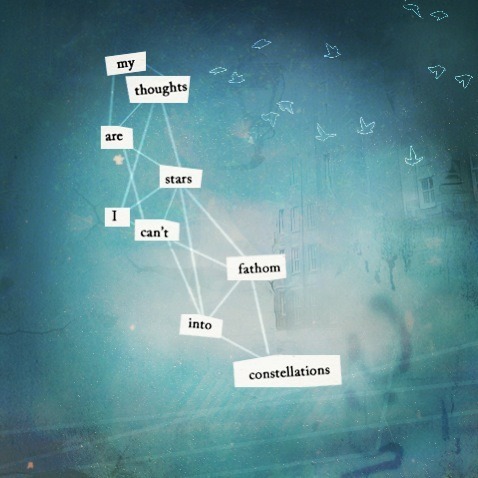
christy1521:

My thoughts are stars I can’t fathom into constellations.
Source: http://the-fault-in-our-stars-quotes.tumblr.com/post/58670292552/christy1521-my-thoughts-are-stars-i-cant#notes
That quote represents, I believe, a fundamental cause of our human weaknesses. We all know what "good" means and we know what is "good." We just don't take the time to always understand how the people and things we interact with in this world can make it very difficult to see the connection between a decision we need to make at any given point in time and what is truly "good". 

A constellation is a series of connections, a network, a system of otherwise disconnected bodies which someone, at some point in time, connected in a way that created meaning for them. 

What I want to help my children with more than anything, is to recognize their values as stars; bright shining beacons of "goodness" which, when they connect them together and link them to the decisions they make and the actions they take, create a system of "goodness". The key is to always focus on the "stars" in our lives, constantly consider them and pay attention to the choices ahead of us.

We all have the ability to make the connections. To see the linkages in our lives between what we're meant to be doing, living by our core values, and the choices we are forced to make. It's not always easy. The world we live in makes it very confusing. That's why I put so much focus on core values. When we allow them to be the primary drivers of our decisions we dramatically increase our chances to make "good" decisions. We do things that make us feel satisfied with ourselves. We give ourselves the opportunity to be truly happy.


Saturday, February 1, 2014

An Ode to Failure


An Ode to Failure

Note: If the presentation takes too long to load, click here to view it on haikudeck.com.


Everything we do is a value proposition.
Everything we do is an experiment.
The net-value we've reaped from past experiments do not control what we can realize from the next!

I wish you all the best for life-long success! BOOM!

Tom Eakin
Success Engineer at BoomLife 


THE GPS THEORY MODEL

BoomLife provides personal, professional, and organizational success engineering services. Our Values-Based, practical, GPS Theory processes will help you:


Need an Inspirational Speaker for Your Next Event? 
Tom Eakin's presentation of "What Do You Want?" is designed to challenge the way you define success and inspire you to engineer your own personal, professional or organizational path to success. 

GET WHAT YOU REALLY WANT! 
Getting what you want and being the person you want to be can seem complicated and confusing! Together, we'll define what you want, what it takes to get it and help you realize the kind of success you never been able to achieve before! Sign up for personal one-on-one coaching. You can sign up for a program or a single-session. It's up to you!
What's "Success Engineering"? At BoomLife, we believe training isn't enough to help people make the changes they need to make their personal, professional or organizational situation better. In order to learn how to change, one must learn how to change. Success Engineering is nothing more than our brand of coaching. But, our brand of coaching is not like anyone else's, we have GPS Theory!

Sunday, January 5, 2014

One Simple & Easy Way to Help Someone Else

One Simple & Easy Way to Help Someone Else

Not one of us can be successful on our own. It takes people fulfilling all kinds of roles to support our efforts at getting what we want. It's about relationships. It's about our connections to people with whom we've created magical relationships.

Today, as I thanked a new connection on Twitter for following me, I noticed this photo on their profile and it helped me by making me stop and think for a few minutes about how I measure success.


I'm not a preacher. However, I do invest a significant amount of energy in my efforts to help people achieve life-long success. I believe getting someone to say, "I will do something!" is really close to the true measure of success for me. Close, but not quite it. 


The true measure of success, for me, is when someone says, "I am doing <> to get what I want and be the person I want to be!" Some will say I'm splitting hairs; it's a small difference in meaning but significant just the same. There is often a world of difference between what one says they want to do and what they actually do.


The One Simple & Easy Thing You Can Do


Today I'm interested in helping you by getting you to stop and think for a minute. Then, I want you to do something. 


I want you to share a story about how someone else has helped you and the value it has created in your personal life, professional life, or organizational situation.

Don't know how to write a story? Here's all you need to say, "I am sharing news about how <> has helped me solve <> so you'll know they can help you if you have the same problem!" 

Who will you be helping?

  • The people you're sharing your story with- By telling them about someone who can help them if they need a solution to the same problem.
  • The person, people, or organization who helped you- By promoting their actions and helping others see the value they can create.
  • Yourself- You'll be sharing, giving, helping, and connecting people who can create mutually beneficial, magical relationships!


I can't wait to read your stories! And, the stories those stories create!

I want to give you my free e-book, the "BoomLife Success Planning Guide". Download it and get 7 sessions via email that will help you identify and define your core values so you can live life the life you want, with conviction! It's my way of helping people who want to live truly inspired lives! Want to learn more about it first? You can read about it in my last article, "Setting New Goals? You Need a System!"

BOOM!

Tom Eakin
Success Engineer, BoomLife, LLC
Values-Driven-Success


BoomLife provides personal, professional, and organizational success engineering services. Our Values-Based, practical, GPS Theory processes will help you:

Sign-Up for BoomLife's Newsletter to stay informed of updates, events and news about GPS Theory!

Looking for the Right Self Improvement Opportunities?
Try our GPS Theory App at www.goboomlife.com


Need an Inspirational Speaker for Your Next Event? 
Tom Eakin's presentation of "What Do You Want?" is designed to challenge the way you define success and inspire you to engineer your own personal, professional or organizational path to success. 
email us at tom@goboomlife.com

GET WHAT YOU WANT! 
Getting what you want and being the person you want to be can seem complicated and confusing! Together, we'll define what you want, what it takes to get it and help you realize the kind of success you never been able to achieve before! Sign up for personal one-on-one coaching. You can sign up for a program or a single-session. It's up to you!:

Saturday, December 14, 2013

How to Perform First Aid on a Conflict

How to Perform First Aid on a Conflict.

A wound is  an "injury" to the body, "usually involving division of tissue...due to external violence or some mechanical agency rather than disease." "Feelings, sensibilities" and "reputation" can also be wounded when conflict occurs in interpersonal relationships (Source: http://dictionary.reference.com).

A conflict occurs between two, or more, parties who "come into disagreement," due to viewpoints that are "contradictory, at variance, or in opposition," to one another. The magnitude of the meaning of this work can be weighted as heavily as "fight, or battle" or as lightly as "incompatibility or interference, as of one idea, desire, event, or activity, with another." (Source: http://dictionary.reference.com)

In trying to understand the meanings of words we have a tendency to reference extremes. For example, what's the image that pops into your head when you read this word? 

WOUND

Did you picture a "division of tissue" that was caused during a significant conflict event?

What image appears when you read this word?

CONFLICT

Did you picture a scene of "external violence" where people become physically wounded?

I will make an assumption here that the answer to both "Did you picture..." questions was, "Yes." The purpose is to illustrate the reason why it can be difficult to recognize when relationships have been wounded when the conflict is on the "disagreement in ideas, desires, events, or activities" end of the scale. Most human beings will definitely remember if they've participated in something as significant as an argument, a fight or a battle and the physical or emotional scars they received or inflicted on others. We are forced to deal with smaller-scale conflicts constantly but we don't always recognize the impact the more sublime incidents have on our relationships with others.

When Conflict Wounds Relationships. 

When you find you are at odds with people you need to maintain healthy relationships with in order to be successful, the situation creates discomfort. The discomfort comes from the imagined negative consequences you perceive you'll receive if you fail to resolve the conflict. The fear of the punishment drives you to avoid it so you employ a common tactic and create a distraction from it. Let's say, for example, you change the subject, or defer the current one, so the focus of the discussion will shift from the conflict to something else. You move on and leave the conflict unresolved in order to eliminate the discomfort. In this case, you put a metaphorical bandage on the wound.

Unresolved Conflicts Become Infected.

Let's say you have a small wound on your hand with a band-aid on it and you started to see symptoms that indicate it's becoming infected. You would rip off the bandage so you could clean it. Taking off the bandage causes pain and discomfort but you do it anyway so you can treat the infection and allow the wound to heal.

Think back to the relationship wound you put a metaphorical band-aid on earlier. To ease your discomfort you changed the subject, but you didn't resolve the conflict. Changing the subject didn't make the conflict go away. The conflict remains. The problem with unresolved conflicts is, like untreated wounds, they will become infected. They don't go away, they get worse and things can get really messy!


Don't Let the Pain of Ripping Off the Bandage Keep You From Treating the Wounded Relationship. 

The problem with wounded relationships is they don't heal themselves. As conflict festers beneath the bandage you used to distract attention from it, you will experience more and more pain as time goes by. Your attempt to avoid a punishment has only driven you to create a more painful one. The only way to cure your pain is to endure the pain of ripping the bandage off and deal with the conflict directly with the other person. 
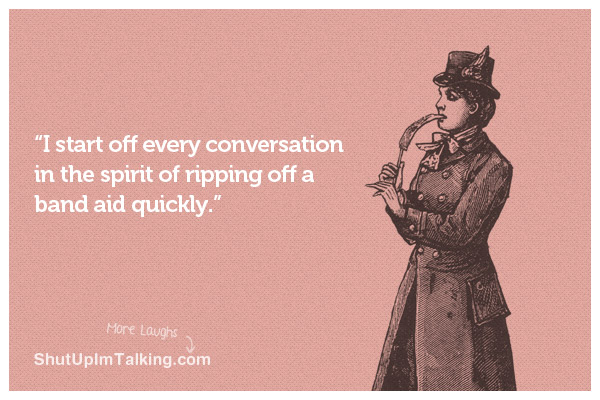
Ripping a Band Aid Off
Source: http://shutupimtalking.com/wp-content/uploads/2012/08/02181.jpg

Failing to deal with conflict directly is like trying to clean an infected wound while it is covered with a bandage. It's ineffective. It doesn't matter how small the wound, the infection is the real relationship killer!

I once worked with a company that was extremely conflict averse. I was hired to help them solve some significant teamwork issues. I observed a few meetings and noticed when employees communicated their disagreement to proposals or statements from others in meetings the president, having the noble intention of wanting to foster a harmonious culture, would stifle the conversation and change the subject. Invariably the unresolved issue would lead to frustration on the part of the dissenter. Deferring the conflict didn't allow them to communicate counter points that had the potential to call attention to problems, suggestions for improvements or intending to point out misalignments. 

The forced end to the conversations invariably led to wounded relationships, frustration and confusion about what the priorities in the organization really were. The leader had good intentions but misunderstood that harmony takes practice. If you don't believe that, listen to a 5th grade music band and compare their sound with that of a senior high school band and recognize the difference practice can make. If an organization is never allowed to operate with conflict, it won't learn how to resolve it. The leader missed the opportunity to facilitate open, honest and respectful debate, which is a form of conflict people can function under in a positive manner. 

As a leader, can you afford to let conflict infect your organization? Can you afford to let the wounds you've created or have observed in other relationships within your organization fester?

Performing First Aid on a Conflict


To avoid setting the conditions that will allow conflict to fester in a relationship it's best to perform First Aid. A clean and treated wound will heal very quickly. The next time you recognize a disagreement is about to be left unresolved, here's how to perform First Aid:
  • Recognize a relationship has been wounded- Think about the potential consequences of hoping it will heal on its own. How much pain will be created if it's left unresolved:
    • For you?
    • For the relationship?
    • For the organization's ability to function efficiently & effectively?

  • Treat the open wound- Stop the avoidance tactic. It will be uncomfortable for you but the outcome you want is to preserve the integrity of the relationship. Show the courage needed to bring the conversation back on track and then:

  1. Evaluate- Ask for clarification. 
  2. Try to Understand the Root Cause- The reason why people put a band-aid on a conflict typically has nothing to do with the difference in points of view that started it. The reason usually stems from to root cause categories:
    • Authoritative Power- When someone disagrees with a person who has authoritative power in a situation, they perceive they are in a coercive situation. This is an opportunity to show you're willing to use reason and logic to show you want to use your power legitimately instead of simply imposing your authority. (Important Note- If you've used authoritative power as your predominant method of influencing situations in the past and you're trying to change perceptions so people will work with you instead of for you, remember it will probably take at least six months of consistent, legitimate use of your power to gain their trust. One slip and you're back to day-one. That's the way people work, sport! Take it seriously!).
    • Frustration from past coercive situations- When people avoid conflict for this reason, they're trying to prevent themselves from communicating inappropriately in the situation. In other words, they're about to say something they'll regret. Recognize their frustration. It's important! If you can't help them relieve their frustration, it will keep building. Ask them if they'd like to talk off-line. If that means the meeting needs to end right there, so be it. They'll appreciate you giving them the attention they deserve (Important Note- See "Important Note" above and apply the same concept here. Think about it.).
  3. Shhhhh...Listen... What did you miss? I promise, you missed something, so focus on
    listening.
  4. Affirm- Let them know you heard them and the points they're trying to make.
  5. Confirm- Try to identify the point of conflict and find out if the other person also recognizes it as the root cause of the disagreement. This allows both parties to focus on the real issue instead of feeling like they're battling each other.
  6. Align- If you've personified the values of COURAGE, PATIENCE, SEEKING and REASON, by following the past five steps, you've set the conditions to become an advocate instead of an adversary. The two conflicting parties now have a common enemy against which they can ally themselves and focus on fighting: The Root Cause of the Conflict. 
Get the win you really want and 
PRE-ORDER FINDING SUCCESS NOW!
Leading the change you want to see in your organization is not easy. It's hard. The hardest part, is changing how you react to the situation. Remember that the behaviors within the organization are a direct reflection of its leadership and you'll find the conviction to do what it takes. 

If conflict already festers in your organization, you won't be able to fix it all overnight. Heal one wound at a time and perform First Aid on the new ones to prevent conflict from infecting your organization to a point where it becomes less effective.  
THE GPS THEORY MODEL


ABOUT THE AUTHOR: Tom Eakin is the author of Finding Success and the Success Engineer at BoomLife. LEARN MORE ABOUT TOM...


Sunday, December 8, 2013

Create the Magic For Every Stakeholder

Create The Magic For Every Stakeholder

Everything you do is a value proposition. 

The simple truth is, every decision you make is an attempt to lean the sum-total of the scales of value in your favor. You want to realize a net-positive value. This concept applies to you whether you’re an individual or the CEO of a business. As a CEO, the ability to sustain success depends on your ability to create mutually beneficial relationships between all of your stakeholders.


So, how do you create mutually beneficial relationships with all of your stakeholders if everyone is always trying to tip the scales in their own favor? The key is to understand the nature of mutually beneficial relationships and set the conditions for creating them with each type of stakeholder.

The magic of any great relationship is that it creates a net-positive value for everyone involved.

When this occurs, the relationship is mutually beneficial. No losers. All winners.

Every CEO must understand how to create a mutually beneficial relationship with all key organizational stakeholders. The answers to how to accomplish that can only come from asking the right questions.:

  • Employees- People will be great at their jobs when what they value aligns with what Leaders want them to do. It’s about the value they perceive they receive in return for their efforts.
    • Do you understand the value your employees perceive in the Compensation & Benefits they receive in relation to the effort they give?
    • Do you understand how key employees find satisfaction in their work?
    • Do you understand how employees perceive their leadership sets them up for success?
    • Do you understand how satisfied your employees are with their relationships with the people they work with:
      • Leadership?
      • Co-Workers?
      • Customers?
    • Do you understand how to find the best fit for the job and the culture you want when you hire new employees?
(c) Copyright- Thomas Eakin, 2013


  • Leaders- People will be great leaders when they can provide the purpose, direction and behavioral drivers that are in alignment with what the people they want to lead value. 
    • Do the leaders in your organization personify the values you need them to in order for them to create a net-positive value proposition for your employees?
    • Do the leaders in your organization make decisions in alignment with organizations Core Values by placing the priority on the principles that will result in maximizing the net-value in every situation?


  • Vendors- People will be great at giving you what you want, when you want it, in the quantity you asked for and at the price you are willing to pay when your organization can satisfy their needs.
    • Do you understand what the value of the products and services they are providing to your organization?
    • Do you understand what net-negative conditions your organization creates for its key vendors?
    • Do you understand how your organization can help key vendors find solutions that create value for you and them?


  • Customers- People will be great customers when what they value is in alignment with what you want them to do. You want them to buy from you.
    • How do you make sure they perceive the net-positive value required to compel them to buy from you?
    • Do you know if they perceive a net-positive value from the products and services you provide?
    • Do you know where you’re exceeding expectations?
    • Do you know where you’re not realizing the value proposition for your customers?


  • Organizations- Groups of people can create a mutually beneficial net-positive value when they can consistently translate the core values and principles upon which the organizational value proposition is founded throughout the processes within which products and/or services are created and delivered.

Are you creating the magic?

Is your organization holding up your end of the value proposition for all of your stakeholders? 

In order to realize a net-positive value for yourself, you need to create a net-positive value for everyone else, your success depends on it.


  • Do you understand where the greatest risks exist in each of the relationships your organization needs to maintain in order to sustain success?
  • Are your strategies purposefully designed to mitigate those risks?


If you want to get the right answers, you need to ask the right questions. BoomLife has the Success Engineering tools to help you do both:
  • Values-Based Seminars & Workshops.
  • Coaching.
  • Organizational Development Consulting.
  • Powerful Surveys- Designed to ask the right questions.
    • Leaders
    • Employees
    • Customers
    • Vendors


ABOUT THE AUTHOR: Tom Eakin is the author of Finding Success and the Success Engineer at BoomLife. LEARN MORE ABOUT TOM...


Wednesday, November 27, 2013

Don't Doom Your Initiative With This Word!

This Word Dooms Change Initiatives

If I told you, "You should know better," does it mean you do?

If I told you, "You should do it the right way," does that mean you can?

If I told you, "We should eliminate the word "should" from the English language," do you think it will happen? 

How many times have you sat in a meeting and heard someone in a leadership position make a "should" statement because they're not happy with the way things are going and they want to initiate changes? They say things like, "That shouldn't happen! We should change this!" Did you notice a lot of heads nodding in agreement? Probably. 

How many times have you seen changes that "should" happen actually become real?

"Should" Misrepresents Reality About What People "Know"

We all have different experiences which have shaped how we think and how we perceive what is going on around us. What seems like common sense to one person is foreign to another. Thinking or, even worse, saying someone else should know something you think you know implies they are perceiving and thinking exactly the same way you are. The guy on the island in the cartoon, below, will think the guy in the boat is an idiot for being so happy to have found land...and vice versa. The problem: At this moment, neither has any perspective on the other's situation.

Its all about Perspective (Humor)
Source: http://spiritualartwork.wordpress.com/2013/05/06/its-all-about-perspective-humor/

"Should" Assumes The Right Way Is Your Way

Sometimes you realize success. This often translates later into a perception you have achieved some level of expertise as it pertains to that succcess. The problem is, everything changes and you don't always get the results you want when you try the same things in different situations. Saying someone "should" do things the right way, implies the conditions present during past successes exist in the current situation. 

Insanity: doing the same thing over and over again and expecting different results. --Albert Einstein
"Should" also implies the criteria for success is the same for everyone. The difference between the behaviors you would have expected to observe after reading the article referenced on the cover page of the issue of People Magazine when it was published some years back and Miley Cyrus' current version of "The Right Way," I suspect, is miles-wide. Is Miley wrong? Was Billy Ray Cyrus wrong? Who is right? Who knows? I'm only a human being and therefore not qualified to judge. The purpose here is only to illustrate that one person's version of "The Right Way," the way one "should" behave is, almost invariably, different from anyone else's. It doesn't matter if it "should" be that way, or not. It is that way.

"Should" Makes It Optional

If you want to change conditions in your situation, you must "Do" what it takes to make it happen. Change must be led. You must provide, purpose, direction and the appropriate behavioral drivers to accomplish the change you want. Otherwise:
  • No one will understand why they need to contribute to the effort.
  • No one will understand what they need to do to contribute, or when to do it.
  • No criteria for success is communicated and understood. There is nothing to work toward.
  • It is an option. Why? It's not a direction. If you're lucky, one person might do something different. Keep hoping for that and that the "something different" is what you had in mind, sport!

How To See The Changes You Want Actually Happen

Do you want things to change? Of course you do.  So Stop, Think, Communicate, Plan, Execute, Monitor, Adapt.

  • STOP- Don't react and make a "should" statement. It will be meaningless and impotent. Stop. Don't speak yet.
  • THINK- Why do you want it? What value will the effort create if it is successful? What do you want? Define your vision. Set clear standards for the results you seek. Take the time to understand what it will really take to cure your pain. Who needs to be involved? What resources are required? Think! Think about whether you are willing to do what it takes to lead the change you seek. If not, don't say another word about it to anyone until you are. You will have more opportunities to think about it, I promise. Why? Because until you commit to leading the change, it won't...even if it "should".
     
  • COMMUNICATE- If you believe you are willing, clearly communicate your vision and purpose to the people who can help you plan and execute. Be ready to listen. Be open to changing your vision to something you hear that might make it better.
  • PLAN- Identify the things people will (notice the absence of the word "should" there?) do to make it happen. Focus on whether the actions will contribute to your vision. If they do, add them to the plan. If they won't, don't. Task organize (who, what when, where & how).
    Communicate, Listen, Listen, Listen. Adjust the plan based on feedback that will improve it's probability of success.
  • EXECUTE- You've set the criteria and the conditions for success. Make it happen. Did you notice it yet? You're leading.
  • MONITOR- Your people are making it happen with zero "shoulds" and a whole bunch of "will". Pay attention to what's happening. Compare reality to the plan. Are you getting what you want (time, effort, results)? If so, make sure you're handing out high-fives and belly bumps like they're hard candy at an Independence Day parade! They deserve the recognition.
  • ADAPT- If you're not getting what you want, Stop & Think! Yes, that's right, you have to go back and change the plan. It's not good enough...even if it "should" be. Then you need to lead the change...again...again...again. 
Julie SHOULD run a brush through
her hair when she gets out of the
wind or it will be tangled. She might.

The word "should" will probably not be removed from the English language. You, however, can lead yourself to change how you misuse it. STOP. THINK of the value such a change could create if you were successful!  

Food for thought: Here is a test to illustrate why "should" is a word to avoid whenever possible: 
Go to http://www.visualthesaurus.com/ and look up "Should". What do you get? Is it what you "Should" get? Interesting, isn't it?  

The Visual Thesaurus is a great tool! I use it all the time to help me understand the relationship between words...especially words that represent values. The words we use are important, they shape the way we think, the way we listen, the way we respond and react to what we hear. What do you hear when the word "should" is used? What did you get when you ran the test on "should" with the Visual Thesaurus? The way I would answer both questions is, "Something else". You don't get what you think you "should," you get "something else".
Disclaimer: I am a human being. I have used "should" inappropriately many times. If you look, I'm sure you will find evidence. It's not important. This is important: I am constantly trying to change and improve. I not only should but will keep trying.

Are you a human being too?


Do you want to see changes in your organization? What do you WANT? Do you KNOW what to DO to get it? Will you BE a Leader?

THE GPS THEORY MODEL


BoomLife provides personal, professional, and organizational success engineering services. Our Values-Based, practical, GPS Theory processes will help you:


Sign-Up for BoomLife's Newsletter to stay informed of updates, events and news about GPS Theory!

Try our GPS Theory App- www.goboomlife.com


Need an Inspirational Speaker for Your Next Event? 
Tom Eakin's presentation of "What Do You Want?" is designed to challenge the way you define success and inspire you to engineer your own personal, professional or organizational path to success. tom@goboomlife.com

GET WHAT YOU WANT! 
Getting what you want and being the person you want to be can seem complicated and confusing! Together, we'll define what you want, what it takes to get it and help you realize the kind of success you never been able to achieve before! Sign up for personal one-on-one coaching. You can sign up for a program or a single-session. It's up to you!: